
Aquaculture
Ozone Treatment Systems for Aquaculture and RAS
Controlled water polishing in RAS and hatchery loops with residual-ozone management.
Application conditions determine the final process, ozone dose and equipment configuration. Start with the treatment objective and actual project data.
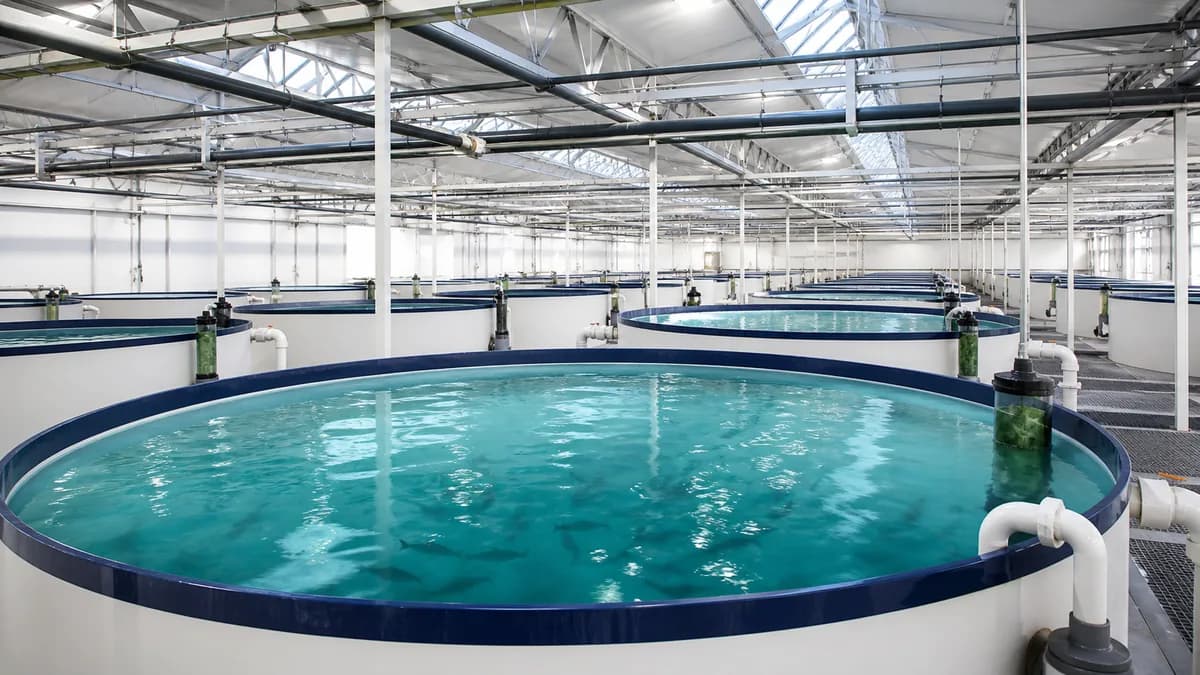
Application environment
Direct answer
Aquaculture ozonation should be engineered as a controlled side-stream treatment stage: water is diverted from the culture loop, contacted with ozone, passed through residual destruction and degassing, and monitored before return. The design depends on the actual water matrix, flow, organic load, salinity, temperature, feeding and biomass profile, and biofilter arrangement; uncontrolled ozone residual must not be returned to culture tanks.
Good fit when
- A defined RAS, hatchery or aquaculture side stream with stable hydraulics
- A measurable water-quality objective and representative operating data
- Systems able to provide residual control, degassing and monitored return
Do not assume
- Direct or uncontrolled ozone return to culture tanks
- Using ORP as the only dose or biological-safety control
- Promising disease prevention, stocking-density gains or pathogen outcomes
Application Overview
In recirculating aquaculture, ozone is normally applied in a controlled side-stream treatment stage. Oxidation-reduction potential, residual ozone, contact and degassing must be managed to protect stock and biological filtration.
Design basis and practical limits
A defensible ozone process starts with representative project data. These inputs should be confirmed before equipment output or dosage is finalized.
Design inputs to provide
- Total loop flow, turnover profile and proposed side-stream flow
- Freshwater or saltwater chemistry, temperature and pH
- Species, life stage, biomass and feeding profile
- Organic load, turbidity, color, solids removal and biofilter arrangement
- Treatment objective, monitoring points and acceptable return condition
- Available oxygen, power, cooling, ventilation and off-gas route
Establish demand in the actual water
Ozone demand and decay change with organics, feed, salinity and system operation. A generic dose or a result from another farm is not a defensible design basis.
Use ORP as one indicator
ORP can be useful for trending, but it is not a universal dose setting or direct proof that the return water is safe. Monitoring logic should combine the relevant process measurements.
Protect animals and the biofilter
Contact, residual destruction, degassing, interlocks and the return-water acceptance point must be designed as one safety boundary around the culture loop.
Illustrative process position
- 1
Characterize the recirculation loop
Document flow, water chemistry, organic loading, species and life stage, feeding profile, solids removal and biofilter operation.
- 2
Divert and contact a controlled side stream
Select a treatment flow, ozone transfer method and contact arrangement that remain separated from the culture tanks.
- 3
Destroy residual and degas
Provide a defined residual-oxidant control and gas-release path before treated water can re-enter the culture loop.
- 4
Monitor the return path
Verify the selected operating envelope against water quality, biofilter compatibility and culture-system safety before routine operation.
This sequence is a decision framework, not a universal process prescription. Final process position and acceptance criteria are project-specific.
Treatment roles to evaluate
- Side-stream oxidation evaluated for a defined water-quality load
- Integration with solids removal and biological filtration
- Controlled contact followed by residual destruction and degassing
- Monitored return without a universal production or health claim
Possible project scope
A project is sized as a coordinated treatment system, not as an isolated ozone generator. The final boundary varies by application and site.
- Feed-gas preparation or oxygen supply
- Ozone generation
- Cooling and process instrumentation
- Application-specific dosing or distribution
- Contact or reaction stage
- Residual ozone and off-gas management
- Safety monitoring and control
Data Needed for Preliminary Sizing
- Treatment flow rate and operating hours
- Influent water, gas or process characteristics
- Target pollutant and required outlet standard
- Existing process flow and available contact space
- Available feed gas, cooling water and electrical supply
- Site temperature, pressure and installation conditions
- Project country, schedule and applicable local requirements
Frequently Asked Questions
Why is ozone normally applied in a side stream in RAS?
A separated treatment stage allows ozone transfer, contact, residual destruction and degassing to be controlled before water returns to animals and the biological filter.
Can ozonated water return directly to culture tanks?
It should not return without a designed residual-control, degassing and monitoring step. The acceptable return condition must be established for the species, life stage and actual water matrix.
Is ORP enough to set the ozone dose?
No. ORP can support process monitoring, but it does not by itself quantify ozone demand, prove residual safety or replace water-specific testing and operating controls.
Does freshwater use the same design as saltwater?
No universal design applies. Salinity and the broader water chemistry affect oxidant reactions, demand, decay and the residual-control strategy, so each matrix must be evaluated separately.
Can an ozone system guarantee disease control or higher stocking density?
No. Those outcomes depend on biology, husbandry, hydraulics, filtration, feed, pathogens and many other controls. This page defines an engineered water-treatment role, not a biological outcome guarantee.
What data is needed for a preliminary RAS review?
Provide total and side-stream flow, turnover profile, freshwater or saltwater chemistry, temperature and pH, species and life stage, biomass and feeding profile, solids and biofilter details, water-quality objective, monitoring points and available utilities.
Evidence boundary
GUOLIN's supplied catalogue documents aquaculture as an application category. Published technical evidence supports water-matrix-dependent ozone demand and careful residual management; the supplied materials do not contain an approved aquaculture project result or a universal dose.