
Air-Fed vs Oxygen-Fed Industrial Ozone Generators: How to Choose the Feed-Gas Route
Compare air-fed and oxygen-fed industrial ozone generators by concentration, product-gas flow, utilities, oxygen supply, operating profile and complete-system cost.
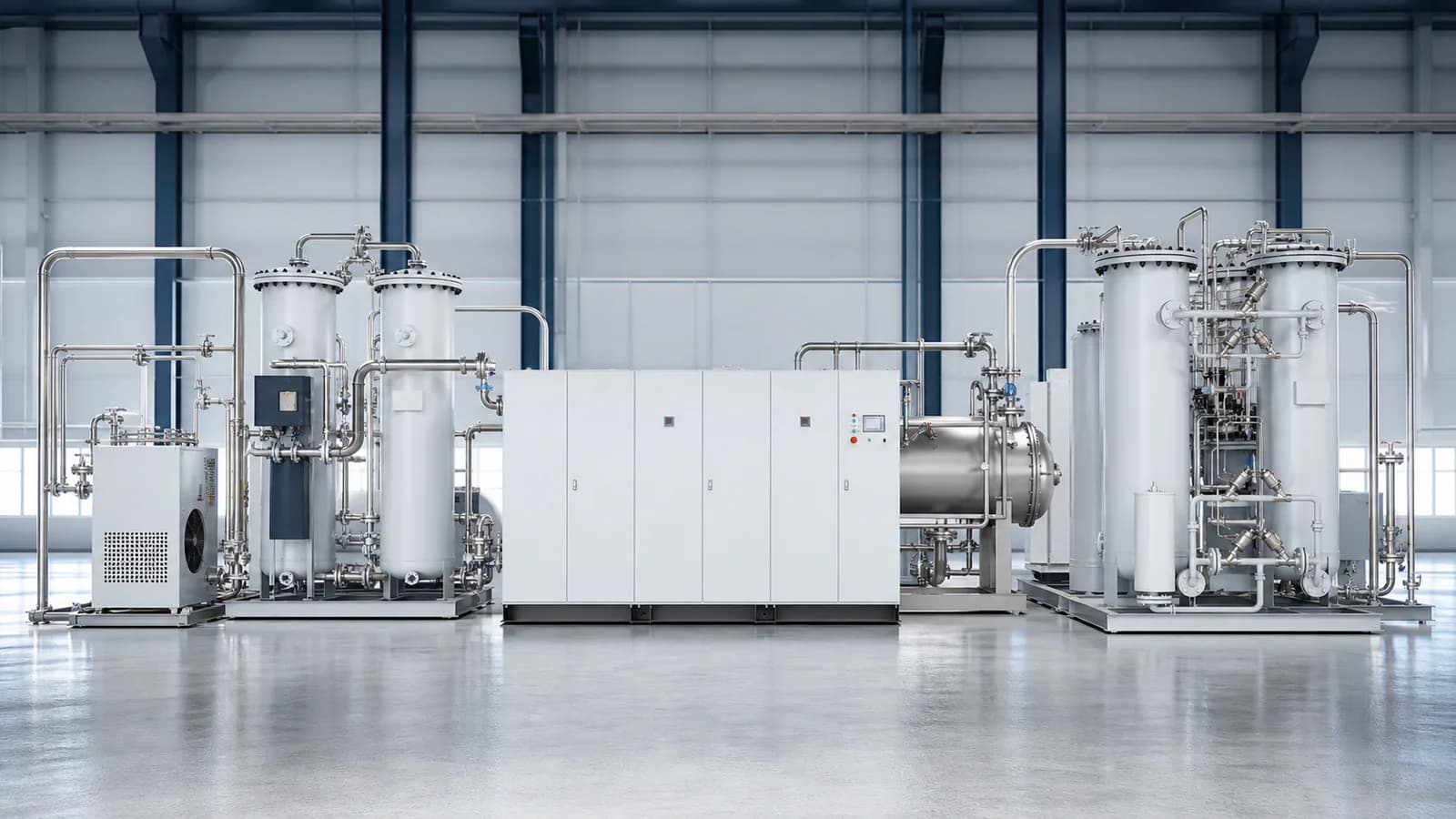
Short answer: do not choose an air-fed or oxygen-fed industrial ozone generator from kg/h alone. Conditioned air is a valid route when the selected equipment can meet the required duty and concentration and the site can reliably operate its air-preparation train. Oxygen-fed generation is usually evaluated when higher gas-phase ozone concentration and lower ozone-product-gas flow materially improve the complete system. The final decision must include the oxygen source, auxiliaries, operating profile, maintainability, local supply risk and connected transfer process—not just the generator cabinet.
This comparison is for owners, EPC teams, consultants, plant engineers and technical buyers defining an industrial ozone system. It explains what changes when the source gas changes and gives a method for requesting comparable proposals. It does not prescribe one feed gas, oxygen purity, dew point, power value or capacity threshold for every project.
Before comparing routes, establish the required ozone duty with the industrial ozone-generator sizing guide. If the treatment objective, transfer boundary or required system functions are still open, first review what a complete industrial ozone system includes.
What do air-fed and oxygen-fed actually mean?
Both descriptions identify the gas supplied to the ozone-generation stage. They do not describe a complete treatment system and they do not mean that ambient air or an oxygen pipe can be connected without a defined quality and control boundary.
- Air-fed: ambient air is compressed or drawn into a designed preparation train, then cooled or separated as required, filtered, dried, regulated and monitored before it reaches the generator.
- Oxygen-fed: oxygen-enriched gas is supplied from an on-site oxygen plant, delivered liquid oxygen or another approved source, then regulated and monitored to the ozone generator's required flow, pressure, composition and condition.
The routes are alternatives for the selected generator configuration. Some generator designs may specify a controlled supplemental gas, but that is a manufacturer-defined operating requirement—not permission to improvise a blend at site.
Alternative feed-gas architectures
Two source routes, one controlled generator interface
Select one route for the offered configuration. Each must deliver the gas condition the generator supplier specifies.
Route A · Conditioned air
Alternative routeThe air-preparation train is part of the industrial system boundary.
Ambient air
Site conditions define the inlet boundary
Condition & verify
Compress, cool, filter, dry, regulate, monitor
Air-source configuration
Supplier states duty, concentration and limits
Route B · Oxygen-enriched feed
Alternative routeOn-site production and supplied oxygen create different utility and logistics boundaries.
Choose oxygen source
PSA / VPSA / supplied oxygen or LOX
Condition & verify
Flow, composition, pressure and continuity
Oxygen-source configuration
Supplier states duty, concentration and limits
Ozone generation
Output, concentration, gas flow, turndown and cooling
Transfer & contact
Injection or diffusion selected for the process duty
Residual gas & controls
Containment, destruction, monitoring and interlocks
Compare both routes at the same delivered duty
A useful comparison fixes the project basis before it compares equipment. Every supplier should respond to the same minimum, normal and peak ozone duty, the same operating hours, the same gas concentration basis, the same site conditions and the same required supply boundary.
Gas-phase ozone concentration and ozone mass output are related, but they are not the same quantity. When ozone concentration is expressed as mass per normal volume, the basic relationship is:
Ozone-product-gas flow at the stated reference condition = ozone mass output ÷ ozone concentration on the same mass/volume basis.
For the same ozone mass rate and the same reference condition, a higher ozone concentration therefore means a lower ozone-product-gas flow. That can change ozone-gas pipework, an injector or diffuser selection, gas-side pressure loss and residual off-gas duty. It does not automatically determine hydraulic contact volume, transfer efficiency or treatment performance. Those still depend on the process liquid or gas, contacting method, ozone demand, temperature, pressure and acceptance objective.
Never compare one proposal in wt% with another in g/Nm³ without confirming the conversion basis. Ask what “normal” or “standard” temperature and pressure are used, whether the value is on a dry basis, where it is measured and which operating point it represents.
Air-fed vs oxygen-fed ozone generator: complete-boundary comparison
The useful question is not “which generator is better?” It is “which complete feed-gas route closes this project's operating cases and interfaces with the least unresolved risk?”
Complete-boundary comparison
The evidence needed before either route wins
Ozone operating point
Air: Use supplier air-source curves
Oxygen: Use supplier oxygen-source curves
Project evidence: Output, concentration and gas flow by case
Source train
Air: Compression, filtration and drying
Oxygen: PSA/VPSA or supplied-oxygen interface
Project evidence: PFD, equipment list and battery limits
Utilities
Air: Air-preparation and generator loads
Oxygen: Oxygen plant/delivery plus generator loads
Project evidence: Normal, peak, start and standby demand
Process-gas handling
Air: Evaluate higher gas flow at offered point
Oxygen: Evaluate lower flow at offered concentration
Project evidence: Transfer and off-gas calculations
Reliability
Air: Dryer/compressor failure and recovery
Oxygen: Plant or delivery interruption and recovery
Project evidence: Redundancy and autonomy case
Maintainability
Air: Filters, drains, dryer and compressor
Oxygen: Adsorption plant/storage and analyzers
Project evidence: Service, spares, skills and maintenance plan
Lifecycle basis
Air: Complete air-route CAPEX/OPEX
Oxygen: Complete oxygen-route CAPEX/OPEX
Project evidence: Same hours, tariffs, scope and outage basis
1. Gas-phase ozone concentration and product-gas flow
Current industrial product literature commonly shows a higher attainable gas-phase ozone concentration for oxygen-fed configurations than for air-fed configurations. Treat that as a configuration relationship, not a universal guaranteed band. Electrode design, power setting, cooling, gas quality, flow, pressure and measurement basis all affect the stated operating point.
The practical evaluation is downstream. Determine whether lower ozone-product-gas flow improves the proposed transfer arrangement, gas-side pressure loss, off-gas volume or equipment layout. Request both concentration and gas flow at minimum, normal and peak ozone output—not only the maximum concentration on a data sheet.
2. Feed-gas equipment and utilities
An air-fed route may need a compressor, aftercooling or moisture separation, filtration, drying, receiver or buffer volume, pressure regulation, instruments and condensate management. The exact train depends on the generator specification and site environment. “Uses air” does not mean “needs no feed-gas equipment.”
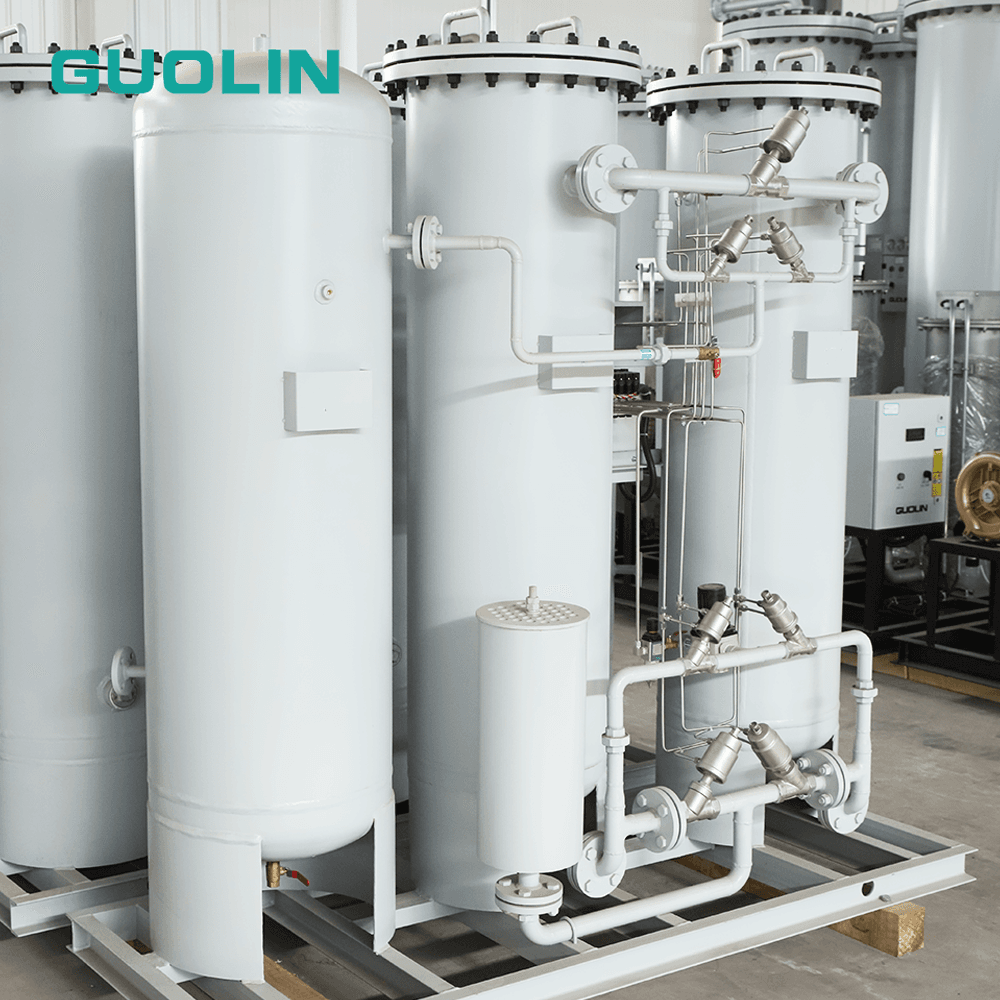
An on-site oxygen route also begins with air. A PSA oxygen-generation package, for example, depends on compressed-air quality and has its own filtration, separation vessels, controls and oxygen receiver. A VPSA oxygen system uses a different pressure/vacuum architecture and must be evaluated at the required oxygen flow, pressure, turndown and site duty. Booster equipment may be required when the produced pressure does not match the distribution or generator interface.
A supplied-oxygen or LOX route can remove on-site air-separation equipment from the owner-operated boundary, but it introduces storage, vaporization, delivery access, supplier availability, inventory management and local oxygen-service requirements. It is not simply “PSA without the equipment.”
3. Generator power is not complete-system energy
Oxygen-fed generator data often show lower generator-specific power than a compared air-fed configuration. That does not establish the complete plant's energy use. Add the actual loads for the air compressor and dryer or the oxygen plant, any booster, cooling and heat rejection, controls, ventilation, gas handling and standby equipment. Then apply the project's hourly load profile and turndown behavior.
This distinction also prevents false cost conclusions. A low generator-only kWh/kg O₃ value cannot prove lower operating cost if the oxygen-production boundary has been omitted. Conversely, a higher-capital oxygen system cannot be dismissed without valuing its effect on gas flow, connected equipment, operating continuity and local oxygen logistics.
4. Reliability, redundancy and operator capability
Reliability comes from the full route, not the label. For conditioned air, review compressor and dryer redundancy, filter/condensate maintenance, instrument coverage and the effect of humid, dusty or corrosive ambient conditions. For on-site oxygen, review compressor or blower trains, adsorption vessels, valves, analyzers, buffer storage, turndown, restart behavior and any booster.
Also ask a less glamorous question: can the site maintain the selected technology? Local technician experience, spare-parts availability, supplier response, consumables and test equipment can outweigh a theoretical efficiency advantage. Where ozone availability is critical, define which failures the standby philosophy must cover and how long the system must operate through a source interruption.
5. Scope and commercial responsibility
Put the boundary in the quotation. State whether the supplier, owner, EPC or gas company provides the compressor, dryer, oxygen plant, LOX storage/vaporizer, interconnecting piping, instruments, ventilation, foundations, utilities, commissioning and long-term service.
Do not compare an air-fed generator package with an oxygen-fed complete plant and call the difference “feed-gas cost.” Use the industrial ozone-system RFQ checklist to issue one inclusion, exclusion and bidder-response schedule.
When is conditioned air a credible route?
Conditioned air deserves a full technical comparison when the selected air-source equipment can meet every required duty and concentration, the resulting gas flow is compatible with the transfer and off-gas design, and the site can reliably provide the preparation train and maintenance capability.
Its evaluation is stronger when:
- the duty falls inside a verified air-source model/configuration rather than an assumed capacity rule;
- the required ozone concentration does not force an unsuitable gas-flow or contacting arrangement;
- ambient air quality and humidity can be managed at the installation location;
- compressor, drying, filtration and condensate responsibilities are explicit;
- normal, peak, turndown and standby cases are supported by supplier data; and
- the complete lifecycle comparison includes air-preparation power, service and consumables.
Air feed should not be selected only because it appears to remove the cost of oxygen. Industrial dry-air preparation is itself a process package, and inadequate gas quality can reduce output or damage equipment. Require the generator supplier's feed-gas specification and protection logic.
When should an oxygen-fed route be evaluated?
Evaluate oxygen feed when higher ozone concentration and lower product-gas flow may materially improve the selected generator and connected gas-handling process, or when the required duty lies within a verified oxygen-source equipment range that the air-source alternatives do not cover.
Then choose the oxygen supply architecture separately:
- PSA oxygen: compare required oxygen flow, purity, pressure and turndown with the complete compressed-air package, receiver, analyzers, redundancy and service plan.
- VPSA oxygen: evaluate the large-plant pressure/vacuum train, oxygen operating points, booster boundary if applicable, footprint, maintenance capability and local technology support.
- Supplied oxygen or LOX: compare storage and vaporization, delivery frequency and access, minimum inventory, supply contract, backup source, site safety requirements and price escalation basis.
Do not assume one of these is automatically cheapest or most reliable. The answer changes with annual operating hours, load profile, electricity tariff, delivered oxygen terms, distance from supply, storage requirements, maintenance resources and the value of lost ozone availability.
What do GUOLIN's air-source and oxygen-source catalogue values show?
GUOLIN's published configurations illustrate why the feed-gas condition must remain attached to every number:
- the compact CF-G-2/CF-G-3 records show 20–30 mg/L for named air-source configurations and 80–120 mg/L for named oxygen-source configurations;
- the published CF-G-2 large-equipment tables state 2–2.5 wt% for air-source configurations and 8–10 wt% for oxygen-source configurations; and
- the current published tables extend to 60 kg/h for air-source equipment and 150 kg/h for oxygen-source equipment.
These are catalogue configuration values—not universal ozone-industry performance, a guaranteed project operating point or a capacity switch rule. The 10–800 g/h compact models, 1–10 kg/h selection range and 10–150 kg/h large-system range must each be checked against the actual duty, concentration, cooling, utilities and system interfaces.
Five project scenarios—and the correct conditional answer
- Lower or intermittent duty with reliable air preparation: an air-fed configuration may be appropriate if its verified operating envelope and connected gas-flow duty fit. Still compare complete utilities and maintenance.
- Continuous duty where product-gas flow constrains transfer or off-gas equipment: evaluate oxygen feed because higher concentration may improve the gas-side architecture. Confirm the complete oxygen-supply load and the process-transfer design.
- Site already has a suitable, reliable oxygen utility: request an oxygen-interface proposal using the actual available purity, pressure, flow, continuity and ownership terms. Do not assume an existing oxygen header is compatible.
- Remote site with uncertain delivered-oxygen logistics: compare conditioned air and on-site oxygen with realistic maintenance, power, spares and backup assumptions. Avoid choosing only from delivered-gas price.
- High-availability municipal or process duty: compare failure modes and recovery time for the entire source train, generator modules, cooling, transfer and controls. Redundancy should cover the failures the owner has actually defined.
No scenario produces a responsible answer without supplier operating-point data. If both routes remain feasible, carry both into the proposal stage and normalize them before selection.
How to compare air, on-site oxygen and supplied-oxygen proposals
Give every bidder the same field list and require normal, peak and minimum values. A useful response separates the feed-gas package, ozone generator and downstream process so omissions remain visible.
Proposal normalization
Compare routes only after scope and assumptions match
A generator quote, a PSA-equipped plant and a delivered-oxygen interface are not comparable until every required function has an owner and a value.
1. Buyer fixes
- • Operating cases
- • Duty and concentration basis
- • Site and process interfaces
- • Availability and scope
2. Supplier returns
- • Gas source and conditioning
- • Performance by case
- • Utilities and auxiliaries
- • Limits, exclusions and evidence
3. Team normalizes
- • Same functional boundary
- • Same hours and local prices
- • Maintenance and spares
- • Supply interruption and outage basis
For lifecycle comparison, request supplier-stated capital scope, utility loads by operating case, planned maintenance, consumables, recommended spares, expected replacement items, oxygen or delivery assumptions, service scope and availability design. The owner or EPC can then apply local tariffs, labor, transport, financing and outage values. Do not ask the ozone supplier to invent one worldwide payback figure.
Feed-gas section to include in an ozone-system RFQ
Required ozone duty: [minimum / normal / peak, with generated or transferred basis]
Gas-phase ozone requirement: [target or supplier-proposed, unit and reference condition]
Operating profile: [hours, turndown, seasonal cases, required availability]
Routes to evaluate: [conditioned air / PSA / VPSA / supplied oxygen or LOX]
Available site utilities: [power, cooling, compressed air, oxygen header if any]
Ambient and installation conditions: [temperature, humidity, dust/corrosion, altitude, indoor/outdoor]
Supplier response: [feed-gas flow, composition, pressure, temperature, moisture/filtration requirements, gas conditioning, analyzers, auxiliaries, redundancy and limits by operating case]
System interfaces: [generator, dosing/contact, off-gas, controls, ventilation and safety]
Responsibility boundary: [supplier / owner / EPC / gas company]
Commercial comparison: [included scope, utilities, maintenance, spares, service, delivery/supply assumptions and exceptions]
Use the industrial ozone-system utility checklist to close the site fields, then compare complete proposals on one basis. The industrial ozone-system product hub shows the generator and supporting-equipment routes, while the solution pages keep the feed-gas choice connected to the actual treatment task.
GUOLIN is China’s only publicly listed ozone-system manufacturer, with complete-system design, manufacturing and integration capabilities. Send the operating cases, treatment objective, available utilities and routes you want evaluated through the technical project-review form. The resulting proposal will define the selected feed gas, equipment, interfaces and supply boundary for the project rather than applying a universal air-versus-oxygen rule.
Frequently asked questions
Is an oxygen-fed ozone generator always better than an air-fed generator?
No. Oxygen feed generally supports a higher gas-phase ozone concentration and lower product-gas flow for the same ozone mass, but the project decision must include the oxygen source, auxiliaries, operating hours, transfer process, maintenance, local supply risk and complete lifecycle basis.
At what ozone output should a project switch from air to oxygen?
There is no universal g/h or kg/h switch point. Compare verified equipment configurations at the required minimum, normal and peak duty, concentration, product-gas flow, operating profile, utilities, availability and project boundary.
Does an air-fed industrial ozone generator use untreated ambient air?
Normally no. An industrial corona-discharge air route requires the feed gas to meet the selected generator's condition limits. The package may include compression, cooling or separation, filtration, drying, regulation, monitoring and condensate management.
What oxygen sources can feed an industrial ozone generator?
A project may use on-site PSA or VPSA oxygen generation, supplied gaseous oxygen, liquid oxygen with storage and vaporization, or another generator-approved source. Required composition, flow, pressure, continuity and responsibility boundaries must match the offered ozone generator.
Why does ozone concentration matter if two systems have the same kg/h output?
At a common gas-reference basis, a higher ozone mass concentration means less ozone-product-gas flow for the same ozone mass rate. That can affect gas piping, injector or diffuser selection and off-gas duty, although it does not by itself determine transfer efficiency, hydraulic contact volume or treatment performance.
Does lower generator-specific power mean lower total operating cost?
Not necessarily. Add air preparation or oxygen production, any booster, cooling, ventilation, controls and standby loads, then apply local tariffs and the actual operating profile. Include maintenance, consumables, delivered-oxygen terms and outage risk before comparing lifecycle cost.
Is PSA or VPSA oxygen better for an ozone system?
Neither is universally better. Required oxygen flow, pressure, purity, turndown, booster need, site power, footprint, maintenance skill, spare-parts supply and proven local support determine the appropriate adsorption route. The ozone generator supplier must confirm compatibility.
What data should I send for feed-gas selection?
Send minimum, normal and peak ozone duty; gas concentration basis; operating hours and availability; water or process data; site power, cooling and compressed-air conditions; available oxygen supply; ambient conditions; transfer/off-gas arrangement; controls; required scope and local service constraints.
Related articles
Buying Guide
Industrial Ozone Generator Sizing for Water Treatment: Inputs, Calculations, and Limits
Learn how to calculate industrial ozone-generator capacity from water flow, defined ozone dose and transfer efficiency—without confusing generated, transferred or residual ozone.
Buying Guide
Industrial Ozone System Utility Requirements: A Site-Preparation Checklist
Prepare power, feed gas, cooling, ventilation, drainage, layout and control interfaces for an industrial ozone system using a responsibility-based site checklist.
Buying Guide
How to Prepare an Industrial Ozone System RFQ: A Specification Checklist
Build a comparable industrial ozone system RFQ with a clear design basis, scope boundary, operating cases, bidder response schedule and acceptance requirements.
Buying Guide
What Is Included in a Complete Industrial Ozone System?
See which equipment, controls, utilities and project interfaces may be included in a complete industrial ozone system—and what every proposal must define.